Elvis may have left the building, butAustin Butleris just arriving.
But Butler’s performance is earning raves from critics andthe Presley familyalike.
The early Oscar buzz is nice, but the latter opinions are what matter most to the actor.
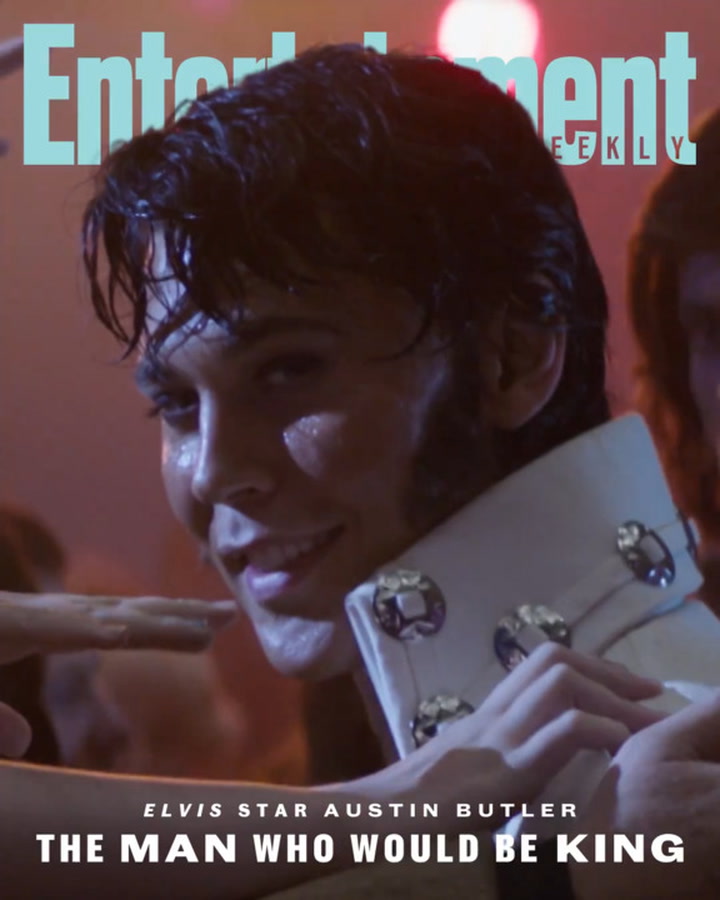
Austin Butler in ‘Elvis’.Warner Bros. Pictures
Interviewing Butler feels like an exercise in time travel.
From impersonators to Vegas wedding officiants, Elvis Presley has been imitated and parodied ad nauseum.
Filmmakers have fictionalized him since the late 1970s, beginning with directorJohn Carpenterand starKurt Russell’s1979 TV movie,Elvis.

Austin Butler in ‘Elvis’.Warner Bros. Pictures
He’s been the subject of documentaries, as well as the star of over 30 films himself.
“My big goal right from the beginning was not becoming a caricature of him,” he says.
By now, the story of how Luhrmann chose Butler has already started to codify into legend.

Director Baz Luhrmann and Austin Butler on the set of ‘Elvis’.Hugh Stewart/Warner Bros.
But what was it about that tape that convinced Luhrmann Butler was the guy?
“There’s nothing more precious or important to me than to curate an actor,” Luhrmann says.
It’s real, and that’s what got my attention."

Austin Butler in ‘Elvis’.Warner Bros. Pictures
Hanks remembers watching Butler’s audition tape four times in a row.
Ultimately, my face is different.
I had this false expectation in the beginning that I could make my face identical to his.

Austin Butler as Elvis and Helen Thomas as Gladys in ‘Elvis’.Warner Bros. Pictures
Ultimately, I realized that doesn’t serve the story or me at all.
It’s about his spirit.
It’s about merging our two souls."

Austin Butler in ‘Elvis’.Warner Bros. Pictures
(“I saw Elvis in those eyes,” he muses.)
Then there were performance elements the voice, the swagger, the way he danced and moved on stage.
“Your muscles get quite fatigued, and you have to build up stamina with those things.

Baz Luhrmann and Austin Butler on the set of ‘Elvis’.Hugh Stewart/Warner Bros.
My body still feels it.”
He worked with the film’s movement coach, Polly Bennett, to locate Elvis in his body.
“We’d find these moments that could somehow express his humanity,” Butler says.

Tom Hanks as Colonel Tom Parker and Austin Butler as Elvis in ‘Elvis’.Hugh Stewart/Warner Bros.
He describes it as an inevitable crash that came once the adrenaline of making the film was gone.
“It was all-consuming,” he explains.
“Then my body just said, ‘All right, I need to rest.'”

Baz Luhrmann, Olivia DeJonge, and Austin Butler on the set of ‘Elvis’.Kane Skennar/Warner Bros.
On the surface, the two men are miles apart.
Am I going to get too shy?’
That was something I could rest in."

Austin Butler and Tom Hanks in ‘Elvis’.Warner Bros. Pictures
“It came with this letter from Colonel Tom Parker that Tom had written,” says Butler.
Unable to rehearse together in person due to COVID-19 restrictions, the two kept writing letters back and forth.
There was bona-fide true affection, and dare we say it, love."
Butler stresses Presley’s spirituality as his path to Elvis' soul.
“It was always about the music moving him.
Being in that gospel church was a pivotal moment for me.
Everybody just started wailing.
That was the moment where I felt my soul stirring.
But Luhrmann didn’t ease Butler into it.
Many consider it the most pivotal moment of Presley’s career so, you know, no pressure.
Luhrmann admits that beginning with the ‘68 Comeback Special was intentional.
The director describes Butler as a roiling mass of energy.
“He was killing himself,” says Luhrmann.
“I know that sounds dramatic, but I was frightened he would break.”
“We just said, ‘Let’s do it, and it’ll blow out all the energy.
“Let’s do the most difficult moment first.”
“I was so scared and felt like everything was out on the line,” he recalls.
“And then I realized that everything was on the line for Elvis, too.
“I had this complete out-of-body experience,” he continues.
I’m hearing the audience scream in the same way.
I’m feeling the same fear and pouring it into the song in the same way.
That transcended what I expected that moment would be.”
This feeling wasn’t exclusive to Butler either.
“We felt like we had witnessed Elvis,” says the director.
“We were in a time machine, and we were there.”
“I wasn’t asking people to call me Elvis or anything,” he says.
“I was just constantly working at humanizing him.
It was trying to find any keys that would lead to that place.”
“I lived in that world the whole time,” elaborates Butler.
“That’s the environment Baz creates.
Even off-set, everything flows in the same aesthetic.”
“It was shooting a fever dream by way of an opera,” quips Hanks.
“for play jazz, you have to know music theory,” adds Butler.
That’s how Baz is, because he works so hard at preparation.
His father introduced him to classic movies, watching a different one nightly, often on Turner Classic Movies.
“It was like watching magic,” he marvels.
So I became obsessed with that idea of: How do you find truth like that?
Why have we been telling stories around campfires since the dawn of time?
Butler assures us he did take advice from Hanks.
“He saw that I was all-consumed,” Butler says.
Replenish yourself and remind yourself of other things that are happening.’
That’s something I’ve tried to take on.”
There’s the aforementioned hospitalization, and also a day where he admittedly tried to push himself too far.
“I kept going with the song,'” he remembers.
I had to get stitches in my face.”
Butler confesses that he still hasn’t shaken off the presence of Elvis in his daily life.
Elvis has made him more comfortable in his own skin.
“I used to never dance,” he says.
“I’d be on the wall.
But now, after asking [myself], ‘Why do you move to music?’
to feel what he was feeling, I can’t help but move to it.
“I’ll pop on his music or watch one of his films.
It’ll always be a close part of my life.”
And perhaps Butler doesn’t need to be in any hurry to let Elvis go.
Whether or not he believes it, Elvis Presley is Butler’s magic trick.
He can never go back to life before playing Elvis.
But why would he want to?
